28 August 2026 · 5 min read · By Agnes Veresoni
A defect texted to a subcontractor vs. one that's tracked: what happens after handover
A defect noticed on a walkthrough is usually handled the same ordinary way: a photo, a text to whoever's responsible, and a mental note to check it's been sorted before the project wraps up. During construction, with everyone still on site and the group chat still active, that's often enough. It's the defects liability period — months after handover, once the site team has moved on to the next job — where that same informal channel quietly stops working.
The gap isn't noticing the defect — it's proving what happened to it
Nobody struggles to text a photo of a cracked tile or a door that doesn't close properly. The failure mode shows up later, during the DLP or after it: an owner or occupier says a defect was never fixed, the subcontractor says it was, and there's no record either side can point to — no timestamp for when it was raised, no confirmation it was ever acknowledged, and no photo of the rectified work to settle it. Whoever received the original text has usually changed phones twice since then, or moved to a different job, and the thread itself was never anywhere a Principal Contractor could search.
It's worse when the defect wasn't reported to the Principal Contractor at all. An owner who notices something wrong months after moving in often has no clear channel back to whoever's actually responsible — no invoice, no business card, nothing but a vague memory of "the tiling guy." Without a way to raise it that reaches the right project, it either gets forgotten or turns into a phone call nobody wants to make.
Why "just keep the text thread" doesn't really solve it
Even when a text thread survives, it doesn't answer the two questions that actually matter months later: was this defect ever formally acknowledged as the subcontractor's responsibility, and is there proof it was rectified, not just a reply saying it would be. A text saying "yep will sort it" isn't evidence of anything once a dispute starts — there's no severity recorded, no phase of the project it was raised in, and no photo of the finished fix sitting next to the original problem.
How Novato handles this
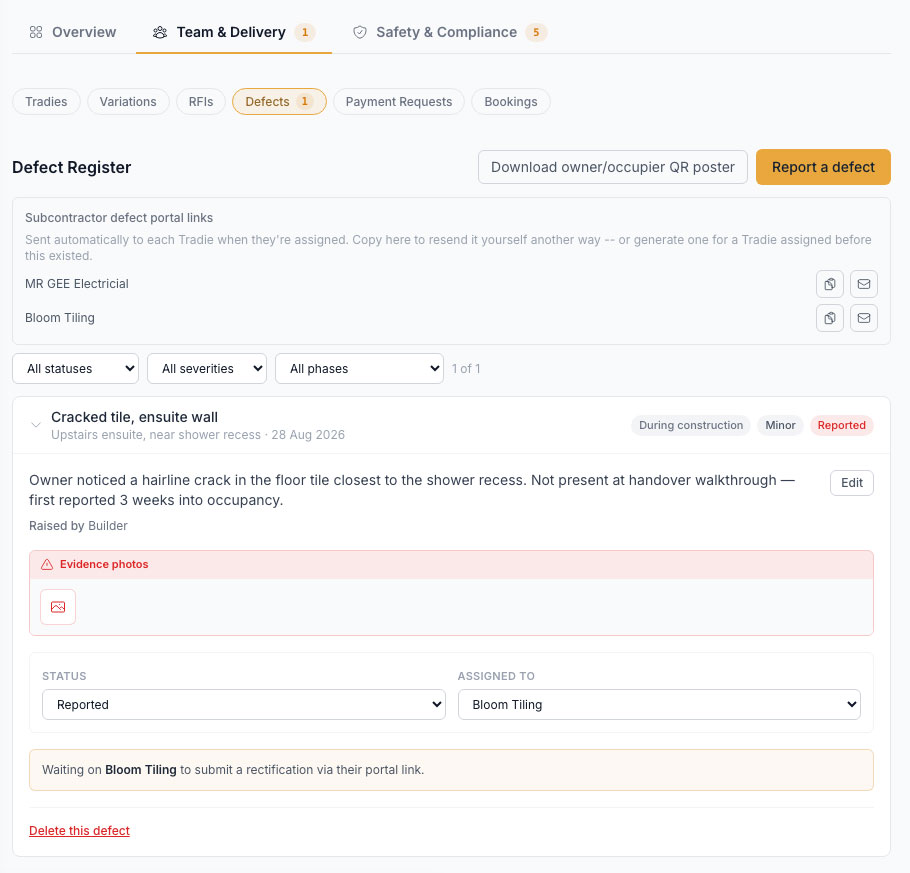
A defect logged in Novato is recorded against the project, the subcontractor responsible, its severity, and which phase it was raised in — during construction, the defects liability period, or post-DLP — with a timestamp the moment it's reported. The subcontractor gets their own no-login portal link, specific to that defect, to acknowledge it and upload rectification photos directly, closing it out themselves rather than relaying updates through the Principal Contractor. For a defect an owner or occupier notices after handover, a downloadable QR poster links straight to a reporting form — no login, no guessing who to call — so it reaches the project record instead of getting lost. Every defect keeps its full history from first report to rectification, still there the same way months later as it was the day it came in.
Agnes Veresoni
Agnes Veresoni writes about construction compliance and WHS for Novato.